You Think You Have a Strategy, But You May Already Be Part of Someone Else’s
Monday, 01 June 2026By Christopher Gleadle

As a financial leader, you are likely navigating an incredibly high-pressure environment. With quarterly reports and immediate ROI constantly dictating your daily rhythm, it is completely understandable why strategy and tactics tangle. When immediate performance is heavily scrutinised, micro-level execution can easily eclipse macro-level vision. However, in an era defined by ambiguity and flux, your ability to distinguish between the macro and the micro is precisely what transforms a hopeful financial projection into an unstoppable reality. For the modern professional, this isn’t just about semantics; it is a fundamental matter of national resilience, resource security, and the long-term protection of capital. Seeing the wood from the trees.
The Fallacy of Digital Over-Reliance

In our collective desire to find tools to navigate this complexity, there is a growing tendency to overestimate what artificial intelligence can currently achieve. In C-suite conversations, it becomes clear that while AI tools are brilliant accelerators, they simply do not remove the need for human judgment, engineering skill, or deep systems understanding.
Overestimating what AI can do risks creating a false impression that deep technical and systems mastery is becoming less important, when the opposite is true. The math is simple: the world will ultimately need more genuine system architects and engineers, not fewer. AI is no replacement for real-world systems skills and unencumbered information flows, both of which you need to maintain a clear awareness of the consequences between decisions over time.
Redefining the Ledger of National Stability
To achieve sovereign resilience, we must intentionally move away from viewing vital resources like energy and water as mere utilities. Instead, treat them as the fundamental ledger of national stability.
If an operational decision is not structurally viable over the long term, it simply isn't sustainable.
Consider these compounding systemic risks threatening our foundations:
- High Energy Vulnerability: Escalating energy prices are the single biggest threat to automated production and energy-intensive manufacturing today.
- The Water Nexus: Energy and water are inseparable and foundational, acting as a dual platform that impacts every vertical layer of industrial and social life.
- The Offshoring Trap: Moving manufacturing abroad to seek secure resources introduces reliance upon external vulnerabilities and foreign agendas, while failing to account for the true embedded carbon emissions of imported goods.
When we allow infrastructure delays to repeat, we shackle first-class engineers and systemically degrade our economies, our environment, and our social cohesion. Geopolitics looms large over these hidden vulnerabilities, burying risk out of sight and quietly undermining your efforts toward growth and net-zero realities.
Operationalising Systemic Resilience
From a systems architecture perspective, integrating energy and water into a unified strategy balances ends, ways, and means. This nexus approach allows you to identify security objectives and organise capital effectively. To operationalise this strategy, your capital allocation must pivot toward three distinct tactical areas:
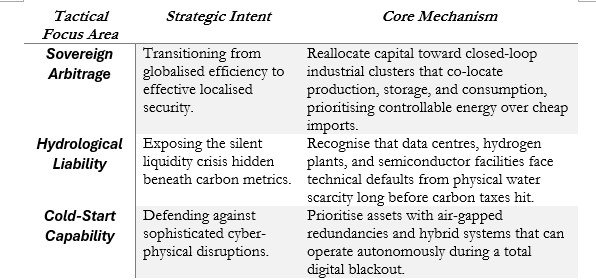
Systems Architecture Playbook
Ultimately, aligning near-term tactics with a long-term strategic vision is your most direct path forward. There is a sobering truth in modern planning: if you do not have your own strategy, you inevitably become part of someone else's. By acting as an active architect of stability rather than a passive observer, you ensure that you own the foundations and, therefore, the future.
To successfully lead your organisation through this transition, here are three high-value insights:
- Price Capital Against a Dynamic Water Stress Factor (WSF): Implement a hydrological covenant to lending to protect industry and food security. Redefine credit risk models to include a WSF to identify stranded assets whose water-to-EBITDA ratio is unsustainable, allowing you to re-price capital for projects that do not implement water recovery systems.
- Prioritise Controllability Over Raw Cost (Resilience-Alpha): Move away from fragile, just-in-time international energy dependencies. Reallocate capital toward localised, insurable, closed-loop industrial clusters powered by domestic, modular sources that carry significantly lower systemic risk.
- Mandate Cold-Start Redundancies in Infrastructure Portfolios: Direct your finance teams to prioritise funding for hybrid infrastructure assets. Ensure critical physical systems possess fail-safe, air-gapped redundancies so they can continue to operate autonomously during a total digital or cyber blackout.
The Bottom Line: if it’s not sustainable and viable, it’s not sustainable.