The Efficiency Illusion: Why Modern Infrastructure Is Failing and How Autonomous Resilience Will Replace It
Wednesday, 19 August 2026By Christopher Gleadle
Modern markets, corporations, and governance frameworks are caught in a dangerous paradox: the harder we optimise individual components, the more fragile the entire network becomes.

For decades, business leaders, policy experts, and investors have treated isolated efficiency as the holy grail of commercial progress. Trimming marginal costs, automating routine workflows, and squeezing every drop of throughput out of supply chains have been lauded as the gold standards of operational excellence. Yet, across climate, energy, finance, and social infrastructure, our dominant systems are malfunctioning under the weight of accelerating extremes and unpredictable feedback loops.
The reason for this widespread breakdown is fundamental: our architectures were engineered for an obsolete era of stability and linear, incremental change.
When complex systems, whether power grids, municipal water networks, or global logistics, are pushed to their absolute limits of isolated efficiency, they lose all structural slack. A single localised disruption propagates instantly across tightly coupled domains. Traditional environmental, social, and governance (ESG) frameworks, largely reduced to compliance checkboxes and corporate PR, are fundamentally incapable of addressing this operational reality. They treat nature, raw materials, human attention, and communities as abstract resources to be compressed onto financial ledgers. But spreadsheets do not dictate physics, physical reality dictates spreadsheets. When abstract financial models1 collide with physical constraints, abstract theory evaporates, leaving brittle systems exposed.
Broken Frames, Not Broken Minds
The systemic failures unfolding across technology, economics, and climate are rarely caused by a lack of human effort, ingenuity or intelligence. Rather, they stem from broken operational framing. Decision-makers across the public and private sectors remain trapped on narrow, outdated railway lines:
- Political structures reset every brief election cycle, prioritising immediate optics over multi-decade structural stability.
- Scientific institutions excel at diagnosing systemic collapse with extreme precision, yet frequently fail to enable practical, real-world action.
- Financial markets optimise aggressively for short-term earnings signals, systematically eroding the long-term viability of the physical assets underpinning those returns.
In the commercial world, founders and executives routinely master the art of serving customers and delivering incremental product enhancements. Yet very few step back to ask whether the very systems they are constructing reinforce the systemic crises they intend to solve.

Local optimisation almost always generates global fragility. Improving one part of a system frequently amplifies stress elsewhere. In energy and water contexts, for instance, optimising a single facility’s electrical efficiency in isolation often shifts thermal or chemical burdens back into the surrounding environment, compounding ecological degradation and creating volatile cost structures for adjacent industries. To escape this cycle, organisations must pivot from isolated efficiency to systems effectiveness: a shift from doing things better to making the entire system work better under real-world conditions.
The Sphere Economy And Autonomous Resilience
To transition from abstract debate into practical execution, leaders require a new cognitive and tactical design framework. This is the central purpose of the Sphere Economy 2: a strategic model created to help individuals regain effective agency and enable nations to achieve true security through Autonomous Resilience3.
Autonomous Resilience is not about attempting the fool's errand of predicting an unpredictable future. Instead, it is about building the internal capacity of a system to self-stabilise, absorb unexpected shocks, and maintain service continuity without relying on continuous emergency capital injections or perpetual external correction. For an enterprise or infrastructure asset to achieve long-term viability, it must fulfil a strict operational standard: it must be profitable, stabilising, and generative. If a solution is not both sustainable and economically viable under physical conditions, its long-term survival is wishful thinking.
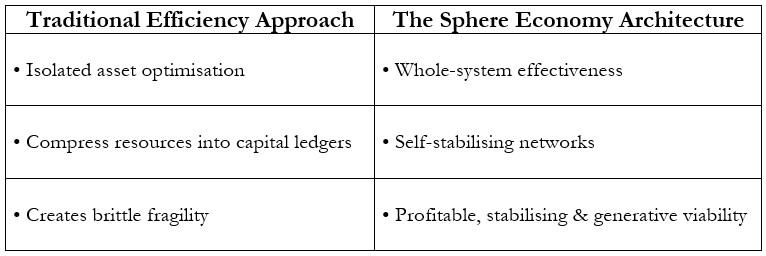
This paradigm shift is demonstrated by SV-Electra, a first-of-a-kind waste-to-energy system developed for the desalination and water production industry. Power generation and water production have historically been treated as separate, competing infrastructures: a dual-infrastructure fragility where rising energy costs destabilise municipal water access, and water scarcity threatens power plant cooling. SV-Electra replaces this fragile model with a system where hardware, software, and physical dynamics directly integrate. Energy availability directly stabilises water operations, while water flows simultaneously balance and stabilise energy generation, creating a mutually reinforcing architecture that thrives under stress.
Moving from Abstraction to Physical Action
The Sphere Economy operationalises transformation through five explicit implementation phases, bridging the gap between theoretical concept and physical execution:
- Frame Breaking: Exposing and dismantling obsolete economic and technical assumptions that prioritise short-term efficiency over system viability.
- Early Digital Prototyping: Rapidly validating structural and operational logic to stress-test system interactions before capital deployment.
- Quick Piloting: Deploying physical hardware and operational systems directly into real-world environments where physical dynamics respond.
- Real-World Observation: Analysing physical happenings, operational stress points, and unexpected failures without institutional distortion or PR bias.
- Scaling and Iteration: Expanding system capacity with empirical confidence, using physical feedback as the primary raw material for refinement.
Frame Breaking ──► Digital Prototyping ──► Quick Piloting
Empirical Scaling ◄── Real-World Observation ◄────┘
This process demands a fundamental re-evaluation of failure. In traditional corporate cultures, failure is viewed as the antithesis of success. In systems architecture, failure during physical deployment is the primary mechanism for gaining the precise feedback required to refine complex operations. True innovators can always identify the exact point where their design performed worst, because that point represents the point of insight.
Reclaiming Human Judgment in the Age of AI
As artificial intelligence reshapes global commerce, the imperative for human-first cognitive systems architecture becomes urgent. AI demonstrates unprecedented capability in accelerating process execution, automating repetitive cognitive behaviour, and processing vast datasets. However, non-biological processes lack lived experience, biological context, and the capacity for moral reflection.
AI can speed up execution, but it cannot decide which problems genuinely matter, which human outcomes are acceptable, or where complex societal systems should be directed. In an attention economy engineered to extract focus rather than cultivate understanding, blindly outsourcing decision-making to non-biological systems risks accelerating social fragmentation and eroding human influence.
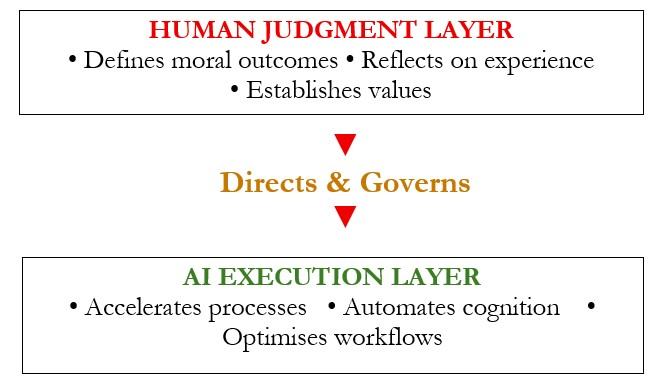
The solution is not to reject advanced technology, but to construct human-first architectures that preserve judgment. When configured correctly, AI serves as an extraordinary amplifier of human wisdom. When misconfigured or blindly trusted, it merely accelerates systemic error at scale. Humans must remain the ultimate anchor, bringing critical thinking grounded in empathy to every system design choice.
Restoring Creative Literacy
Ultimately, shifting our global trajectory relies on rebuilding creative literacy across leadership, industry, and governance. Creativity is not merely artistic expression; it is the essential practical skill that allows us to reconstruct functional alternatives after existing systems malfunction. To think “Can it be something else?” Critical thinking allows leaders to see where operational frames are failing; creativity is what enables them to build what comes next.
By stepping out of abstract debate and entering the domain of concrete, physical creation, human agency returns. Long-term economic value will not be secured by polishing old models or publishing abstract sustainability reports. It will be forged by leaders who build self-stabilising architectures designed to withstand physical reality.
Isolated efficiency trims costs when conditions are smooth, but Autonomous Resilience guarantees survival when conditions turn volatile. True viability isn't achieved by optimising the old machine: it's built by designing the system that holds up when reality hits.