My Word Is Our Bond — Why Civil Law States Keep Buying English
Saturday, 08 August 2026By Professor Michael Mainelli
Not So Common
Our City of London informal motto is “meum dictum pactum” – my word is my bond. It is a boast about trust, and trust is the one commodity every financial centre must manufacture before it can trade anything else. Over a millennium, London's strategy has rested on three virtuous components – create wealth, improve the business and physical environment, and share prosperity – built on four durable themes: defence & security, free & open trade, access to talent, and the Rule of Law. Of these four, Rule of Law is the load-bearing wall. Increasingly, when the world's newest financial centres go shopping for a Rule of Law system, they buy English.
What Rule of Law Actually Means
Businesspeople tend to reach for the phrase without unpacking it, so it is worth being precise. The World Justice Project defines the Rule of Law as a durable system of laws, institutions, norms, and community commitment that delivers four universal principles:
- accountability, under which government and private actors alike are bound by the law;
- just laws, which are clear, publicised, stable, applied evenly, and protective of fundamental rights, property, and contract;
- open government, in which the processes of enacting, administering, and enforcing law are accessible, fair, and efficient;
- accessible, impartial dispute resolution, delivered promptly by competent, independent professionals with adequate resources.
Beneath those four principles sit nine underlying factors, the ones the World Justice Project actually measures, country by country: constraints on government powers, absence of corruption, open government, fundamental rights, order and security, regulatory enforcement, civil justice, criminal justice, and informal justice. The ninth is tracked but not scored comparatively, since informal dispute resolution varies too much between cultures to rank fairly – which is itself an instructive admission from an index-builder. The other eight are scored, weighted, and published for 143 countries every year.

The point businesspeople miss is that Rule of Law is judged in the round, not à la carte. Nobody trading with a nation gets to pick out excellent commercial arbitration and mentally net it off against overcrowded prisons or a corrupt planning department; counterparties price the whole system, whether they say so or not. Rule of Law, to borrow shamelessly from Tolstoy, is an Anna Karenina situation – every unhappy jurisdiction is unhappy in its own particular way, while a genuinely excellent centre has to be competent across all nine factors simultaneously. There is no leaderboard for “best at seven out of nine.”
Two Global Measures, Neither Flattering to Complacency
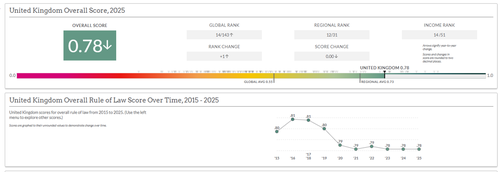
Two published indices are directly relevant to a financial centre's own housekeeping. The first is the World Justice Project's own Rule of Law Index, which in its 2025 edition placed the United Kingdom 14th out of 143 countries and jurisdictions – respectable, but the WJP's own country note attributes the UK's recent slippage to longer court delays, less effective alternatives to litigation such as mediation, and greater perceived government interference in the justice system. That last point echoes a weakness this author has flagged before: access to, and affordability of, civil justice remains the UK's soft underbelly on this measure, even as its substantive law remains the world's most exported.
The second is Transparency International's Corruption Perceptions Index, published every February. The UK's 2025 score of 70 out of 100 is its lowest since the index was methodologically overhauled in 2012, leaving it 20th out of 182 countries – the third year running at that rank, and a marked fall from a top-ten position as recently as 2017. Neither figure suggests a system in crisis. Both suggest a system that has stopped visibly improving, which in a field this competitive amounts to the same thing. London's rivals do not need the UK to fail; they only need the UK to stand still while they advance.

Rule of Law as Infrastructure, Not Décor
For many businesspeople, the importance of the Rule of Law is either taken for granted or not recognised at all – rather like clean water, invisible until the taps run dry. One useful corrective comes from how defence and homeland-security planners in the United States have learned to think about resilience: not as a list of discrete sectors – energy here, water there, finance somewhere else – but as an interdependent structure in which each layer supports the ones above it, and in which legal order sits alongside food, water, energy, and physical security as one of the foundation stones on which everything else – commerce very much included – is built. Strip out the legal foundation and the building above it does not gently subside; it comes down with everything still on the shelves.
The implication for a financial centre is unglamorous but important: Rule of Law is not a marketing line for the general counsel's newsletter, it is critical infrastructure in the same category as the payments system or the power grid, and it should be funded, staffed, and audited with the same seriousness. A centre that treats its courts, its regulators, and its arbitral institutions as cost centres to be trimmed in a difficult budget year is not saving money. It is deferring maintenance on the one asset every other line of business depends upon.
The Numbers Behind the Handshake
The commercial evidence is not sentimental, it is transactional. English law governs roughly 40% of the world's cross-border business and financial transactions, according to the Law Society's 2025 international data survey, putting it alongside New York law as the pre-eminent choice for parties with no geographic connection to either jurisdiction whatsoever. London remains the world's most chosen seat for international arbitration – 34% of respondents named it their preferred seat in Queen Mary University's 2025 survey, ahead of Singapore, Paris and Hong Kong – while the London Commercial Court heard litigants from 93 nationalities in the year to March 2025 and dispatches more than half its contested trials in under a week.
Z/Yen's own Global Financial Centres Index, now in its 39th edition, tells the same story from a different angle. The top four centres in GFCI 39 – New York, London, Hong Kong and Singapore – are separated by a single rating point apiece, the tightest race the index has recorded. All four are common law jurisdictions, or built their commercial courts on common law foundations. Coincidence is not an explanation financial markets are generally willing to accept twice.
Common Law's Widening Commonwealth
What is more striking than the incumbents' dominance is the pattern among the challengers. Since 2004 when the Dubai International Financial Centre opened (Z/Yen had a small hand in nudging these ideas along from DIFC onward), a growing list of civil law states have built common law enclaves inside their own borders rather than reform their national codes wholesale. Abu Dhabi Global Market followed in 2013. Kazakhstan's Astana International Financial Centre, whose court opened in 2018, was candidly described by its own governor as a “copy-paste” of the DIFC: a common law court, English language proceedings, and English law as the governing law, planted inside a civil law state descended from Soviet legal tradition. The International Arbitration Centre attached to it has now handled close to 5,000 cases, roughly 90% with no direct connection to the AIFC itself – parties are actively choosing Astana, not defaulting to it.
The pattern continues. Vietnam's new International Financial Centre, spanning Ho Chi Minh City and Da Nang, took effect under a specialised courts law on 1 January 2026 that explicitly incorporates common law principles and permits the appointment of foreign judges, with English as the primary language of litigation – a striking legislative choice for a civil law state. And in February 2026, Oman issued the Royal Decree establishing the International Financial Centre of Oman, whose founding documents commit it to “a new regulatory, legal, and judicial framework based on English common law,” explicitly following the DIFC, ADGM and Qatar Financial Centre playbook. None of these states is becoming a common law country. Each has instead grafted a common law commercial branch onto a civil law trunk, because that is what the capital they are courting insists upon.
A Cautionary Tale from the West
Common law lineage, though, is not a permanent inoculation against uncertainty; it must be maintained. The United States remains the world's largest common law economy and, on GFCI 39, hosts the top-ranked centre – yet it ranked only 27th of 143 in the World Justice Project's own 2025 Rule of Law Index, with a 2.8% annual decline, and its Transparency International corruption score has fallen to 64, its lowest on record. More than 400 US general counsel surveyed for Norton Rose Fulbright's 2026 litigation trends report separately described “uncertainty” as now “a defining condition for corporate counsel,” citing tariff litigation, shifting regulatory posture, and a fragmenting landscape of state-level business courts. Even Delaware incorporation, long the default choice precisely for its predictability, is being reassessed by some boards as a “strategic variable” rather than a settled convenience. The lesson is not that America is losing the Rule of Law wholesale; it is that legal certainty is a discipline every jurisdiction must keep practising, common law heritage or not, and that the indices above are quite capable of catching a lapse even in the country that invented the jury trial.
Why Common Law Outperforms the Codes for Commerce
Why does the common law method keep winning this particular contest? Partly because judge-made law adapts to novel deal structures – derivatives, tokenised assets, complex structured finance – case by case, rather than waiting for a legislature to amend a code, a process that can take years a fast-moving market does not have. Partly because a deep library of precedent lets negotiating parties borrow tested wording rather than re-litigating first principles in every contract, lowering transaction costs in a way lawyers rarely advertise but clients quietly value. Partly because common law's default preference for freedom of contract, with only a thin overlay of implied good faith, lets sophisticated parties allocate risk explicitly rather than have a court re-interpret their bargain after the fact. And partly, frankly, because English judges are career professionals appointed through a non-political process, which matters enormously to a foreign litigant who has no domestic constituency to protect them.
A practical example of evolutionary flexibility in financial law has been digital assets. Since the emergence of cryptocurrencies in 2009, significant clamour arose for new laws and regulations, not least from the legal profession itself. After much considered thought, led by Master of the Rolls Sir Geoffrey Vos over several years, the Law Commission stated in June 2023, "Digital Assets: Final Report": "We conclude that the common law of England and Wales is, in general, sufficiently flexible, and already able, to accommodate digital assets and therefore that any law reform should be through further common law development where possible." This led to the United Kingdom advancing digital asset recognition through two distinct pillars: the Electronic Trade Documents Act (ETDA) 2023 (nb: six pages!), which legally equates digital trade files to paper, and the Property (Digital Assets etc.) Act 2025 (two pages!), which officially designates crypto and digital items as personal property. No need for a separate body of law, and advancement through evolution as technology and cases emerge.
Recommendations for Every Commercial Centre
None of this is an argument that civil law states should scrap their codes, nor that common law states can rest on their laurels. Though Z/Yen does often point out the potential benefits of connecting a common law zone in a civil centre to wholesale trading markets. Every commercial centre, whatever its legal family, should follow a shorter and more universal checklist:
● Guarantee judicial independence and a non-political, merit-based appointments process, regardless of the underlying legal tradition.
● Publish reasoned judgments promptly and make them genuinely searchable – precedent is only valuable if it is accessible, not merely if it exists.
● Offer real choice-of-law and choice-of-forum freedom, and enforce foreign judgments and arbitral awards without protectionist carve-outs.
● Build a deep bench not just of judges but of arbitrators, mediators and expert determiners, since most commercial disputes never reach a courtroom at all.
● Resist fragmenting jurisdiction across competing state, federal or ministerial bodies – commercial parties price fragmentation as risk, and price it generously.
● Treat Rule of Law as infrastructure, not decoration – fund courts, regulators and registries on the same multi-year, non-discretionary basis as roads or the power grid.
● Submit to external measurement – the World Justice Project's Rule of Law Index and Transparency International's Corruption Perceptions Index are uncomfortable audits, but few systems improve without one, and fewer still improve by ignoring the results.
Conclusion
That the newest financial centres on earth – in Astana (above), Ho Chi Minh City, Da Nang, Tashkent, and now Muscat – have each independently reached for the same wordbook is not an accident of fashion. It is a verdict, delivered repeatedly and at considerable expense, on which legal tradition global commerce actually trusts to keep its word, and it is a verdict grounded in something more measurable than reputation: nine tracked factors, two published indices, and a great deal of capital voting with its feet. London did not invent that trust by accident, and it will not keep it by accident either.