In Space, No One Can Hear Your Pension Scream: The Silent Rise Of SpaceX In Passive Portfolios
Wednesday, 15 July 2026By Professor Michael Mainelli
Into Orbit: The Space Market
On 12 June 2026, SpaceX completed the largest initial public offering in history, raising approximately $75 billion at $135 per share to enter the Nasdaq at a valuation of $1.77 trillion. Within days, SPCX had climbed above $225, briefly pushing the market capitalisation to $2.95 trillion and making Elon Musk the world’s first trillionaire.
SpaceX's peak valuation was roughly ten times the twenty next-largest public space companies combined. Yet that listed universe is more substantial than the headline comparison implies. It spans a wide spectrum: pure-play new-space operators such as Rocket Lab ($602 million in 2025 revenue), Planet Labs, AST SpaceMobile and Intuitive Machines at one end, and the established defence primes for whom space is a major but not exclusive franchise at the other. L3Harris reported $6.9 billion in Space and Airborne Systems revenue in 2025 and has reorganised into a new Space and Mission Systems segment projected to generate $11.5 billion in 2026. Northrop Grumman, builder of the James Webb Space Telescope and operator of satellite life-extension vehicles, brings a $95.7 billion backlog.
The $2 Trillion Telescope Shift
Space industry revenues stood at approximately $625 billion in 2025, with projections of $1 trillion by 2030 and nearly $2 trillion by 2035. The macroeconomic backdrop justifies the excitement. Global satellites underpin at least 18% of GDP in aviation, shipping, telecommunications, timing, and defence; forty per cent of the UN Sustainable Development Goals depend on space data from climate change to deforestation to human trafficking. Over 90% of launches are commercial, not government.
For financial analysts, the SpaceX question is what one is actually buying. Musk himself has floated the extraordinary ambition of $1 trillion in SpaceX revenue by 2030. SpaceX’s S-1 filing with the SEC describes three business segments: Connectivity (Starlink satellite broadband, generating $11.4 billion of its $18.7 billion 2025 revenue and the sole profitable division); Space (launch services via Falcon 9, Falcon Heavy and the developing Starship); and AI (the xAI operation, acquired in February 2026, running Grok models, the X social platform and orbital data-centre ambitions, which produced a $6.4 billion operating loss in 2025). Valuation of $1.75 trillion and $18.7 billion of revenue equates to 95 times trailing revenue — pricing in extraordinary optionality across all three business segments.
The Index Effect: Passive Exposure Whether You Choose It or Not
SpaceX's arrival in the major equity benchmarks is unfolding on a compressed timeline made possible by rule changes introduced specifically to accommodate mega-cap IPOs. FTSE Russell added SPCX to its US indexes on 26 June, triggering an initial wave of forced buying from passive funds. Nasdaq confirmed that SpaceX is allowed to join the Nasdaq-100 15 trading days after listing. The S&P 500 maintains its requirement for positive earnings across four consecutive quarters — a rule that will keep SpaceX out until at least mid-2027.
The implications are twofold. With passive funds potentially forced to replicate a sizeable index weight, SpaceX's price discovery may be driven less by fundamentals than by supply-and-demand mechanics. The float is extremely thin. Musk owns approximately 49% of equity and 85% of voting power, insiders are locked up for at least 180 days, and the IPO represented only around 4.25% of total equity. Mechanical index buying into a near-illiquid float is a known recipe for volatility disconnected from underlying business performance.
Not Just Rockets: The Amazon Analogy
When Amazon disrupted retail, the instinct was to focus on white delivery vans and warehouse logistics. Amazon Web Services was an infrastructure play concealed within the consumer narrative. Amazon has its own space ambitions, but nobody values Amazon by counting its white vans or Blue Origin rockets.
SpaceX invites the same discipline. Starlink is the recurring-revenue subscription base. xAI and orbital data centres are the speculative infrastructure segment, and tough to value. Morningstar’s discounted cash flow model values SPCX at $62 to $63 per share, calling it significantly overvalued at current prices. Paulina Roszkowska, lecturer in finance at Bayes Business School, remarked that at a $1.75 trillion valuation, “investors are owed a little more than poetry” on the data-centre-in-orbit thesis. The range of analytical opinion is itself instructive. Something beyond conventional discounting is driving investor appetite.
Houston, We Have a Problem: Space Debris
Buried within SpaceX’s 271-page S-1 is a disclosure that every space analyst must now treat as material for the entire space sector. The word “debris” appears twenty times. The principal risk factor reads: “The continued proliferation of satellite constellations in Low-Earth Orbit, as well as the risk of collisions with space debris or other spacecraft, could limit or impair our launch flexibility and satellite deployment, which could adversely affect our business, financial condition, results of operations, and future prospects.”
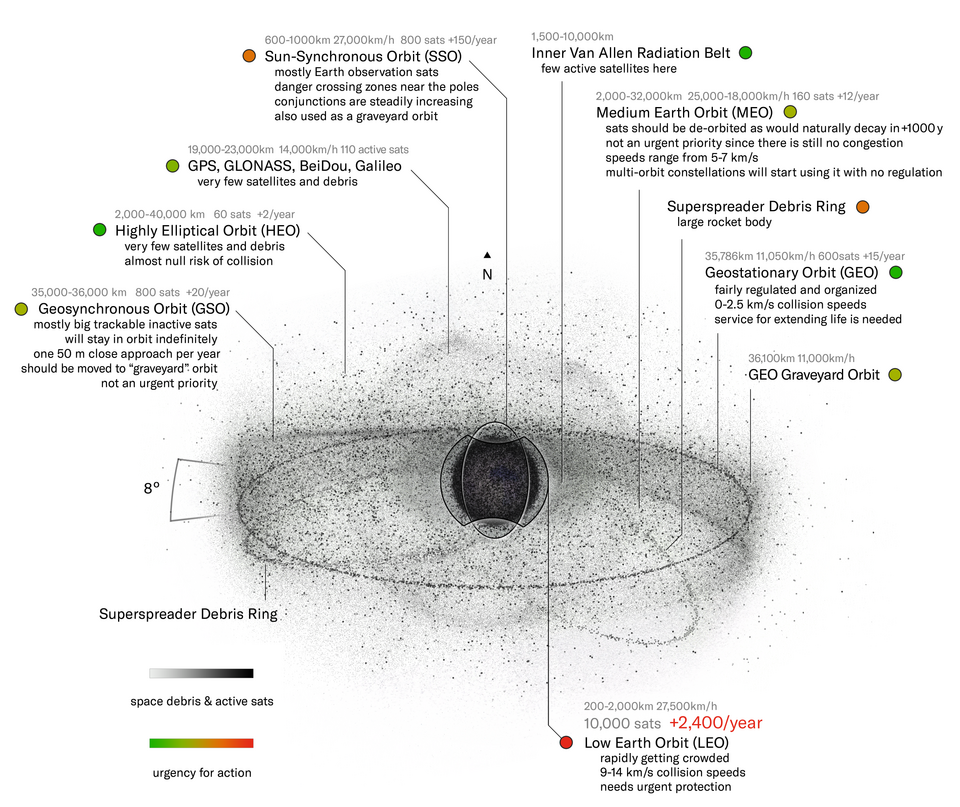
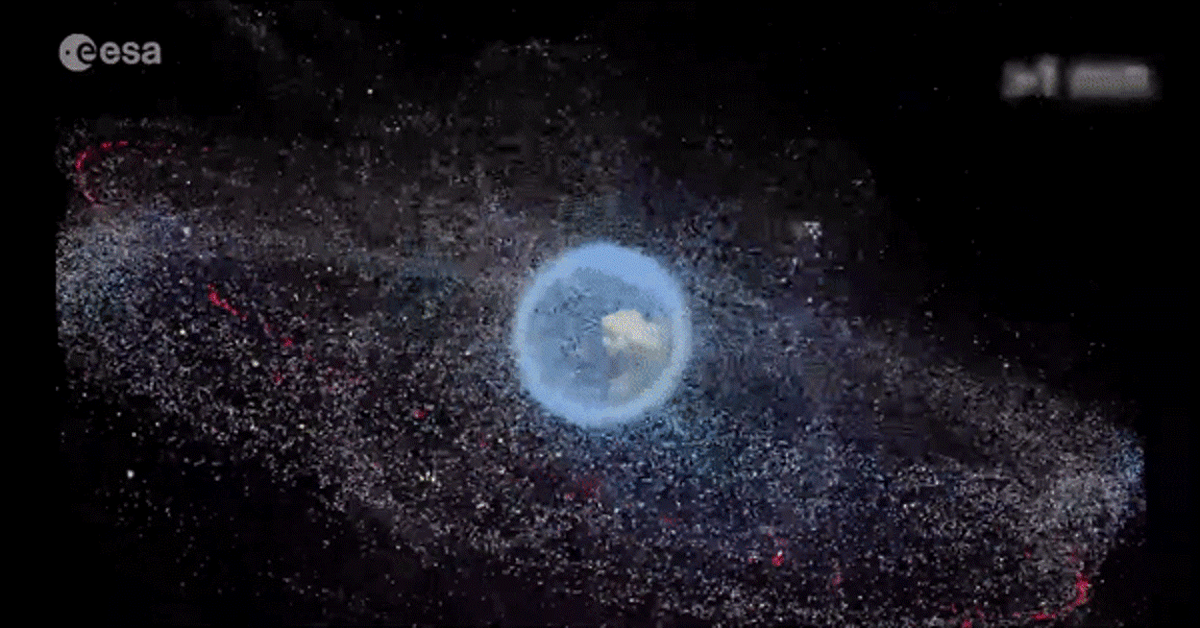
This text was not boilerplate. Alongside 15,000 active satellites, there are 54,000 pieces of tracked debris over 10 centimetres, more than one million pieces greater than 1 centimetre and well over 140 million man-made fragments under 1 centimetre. At typical Low-Earth Orbit (LEO – between 750km and 1,000 km in altitude) speeds of around 17,000 mph a paint fleck carries the kinetic energy of a rifle round.
Things are already unsustainable. Under ‘business as usual’ parameters, the overall space debris population is projected to increase by 60% by 2035. In LEO debris generation from collisions is already outperforming natural atmospheric destruction.
In 1978, NASA scientist Donald Kessler formalised the nightmare scenario: debris density in LEO becomes sufficient that collisions cascade like a nuclear fission reaction, each impact generating material for the next. Sandra Bullock and George Clooney dramatised a Kessler syndrome in the 2013 film Gravity. The debris-generating events of recent decades — the Fengyun-1C ASAT test in 2007, the Iridium-Cosmos collision in 2009, the Russian destruction of Cosmos 1408 in 2021 — each created cascades of new material.
The economic lesson is stark: if Kessler’s cascade triggers, the Starlink constellation — the only profitable segment of SpaceX’s business — is at existential risk.
In November 2025, the Shenzhou-20 spacecraft mission to the Tiangong space station was damaged by space debris requiring an extraordinary rescue operation. SpainSat II was launched in October 2025. In January 2026, space debris particle impact caused a catastrophic loss and a $400 million insurance claim.
Analysts who value SpaceX, or any operator, must price this debris externality. Nobody currently pays the cost of leaving junk in orbit. Space is a tragedy of the commons: like ocean pollution or carbon emissions, the cost is socialised while the benefit of cheap disposal is privatised. Elinor Ostrom, the Nobel economic prize laureate, showed that commons can be governed sustainably, recommending graduated sanctions and financial accountability. Space has neither, yet.
SPADRIBs: The Financial Instrument Analysts Should Promote
The parallel with other resource industries is instructive. Mining operators must post surety bonds, performance guarantees held in escrow, to cover the cost of environmental remediation when a site closes. Maritime operators carry third-party liability insurance as a condition of port access. The obligation to internalise the cost of clean-up is the mechanism by which private actors are made to price externalities that markets otherwise ignore.
Space Debris Retrieval Insurance Bonds (SPADRIBs) apply this logic to orbit. Launched in a paper presented by the 695th Lord Mayor’s Space Protection Initiative to the International Astronautical Congress in October 2023, SPADRIBs would be surety bonds that operators post at the point of launch, redeemable upon demonstrable disposal of the satellite within a defined post-mission window. Six major London Market insurers, led by reinsurance broker AHJ Miller, have pledged coverage of up to US$500 million per operator, subject to two conditions: a successful demonstration of third-party debris retrieval (expected imminently, with Astroscale, ClearSpace and D-Orbit all candidates) and government mandates requiring such bonds as a condition of launch authorisation.
Academic modelling at UCL found that bonds of less than $200,000 per satellite could reduce the annual mass of derelict objects by over one-third and improve aggregate economic welfare, even with only partial global adoption. The 56 nations of the Commonwealth have formally endorsed the SPADRIB framework through their CommonSpace initiative, with a submission to the United Nations General Assembly in November 2024. The next objective is G7 or G20 endorsement of a statement that SPADRIBs will become a condition of launch authorisation.
There are many roles for insurance in space. The OECD has noted that in-orbit insurance “could play an important part in shaping operator behaviour and contribute to covering remediation costs.” For financial analysts, the SPADRIB framework represents the institutionalisation of a risk that is currently unpriced in virtually every space entity.
Telescopic Viewpoints
SpaceX’s IPO has forced space onto every analyst’s screen. A company valued at roughly $2 trillion, trading at nearly 100 times revenue with a $4.9 billion net loss, demands rigorous scrutiny. Everyone shares the space debris problem. A Kessler cascade in the most commercially valuable orbital bands would be catastrophic for SpaceX, for every LEO operator and for the $1 trillion 2030 market projection that underpins much of the sector’s equity story.
Humankind is going to infinity and beyond, but we still need to take out the trash. Active debris removal is technically feasible and approaching commercial demonstration. Insurance-backed surety bonds provide a market mechanism to fund debris removal sustainably, without government subsidy, by internalising the cost into the economics of every launch. Will SPADRIBs be in place to stop debris increasing before collision frequencies require constant Kessler calculations? It is up to us to make them a requirement of launch.
Professor Michael Mainelli is Chairman of Z/Yen Group, who have taken the 695th Lord Mayor's Space Protection Initiative onboard as Z/Yen's Space Protection Initiative. He is also a founding Trustee of Hong Kong based S3+1 - Space: Safety, Sustainability & Science.
[an edited version of this article was published on LinkedIn by George Littlejohn for the Worshipful Company of International Bankers - "Space Oddity - Debris, Through A Telescope Darkly" - https://www.linkedin.com/pulse/space-oddity-debris-through-glass-darkly-george-littlejohn-ocg8e; and also by the Chartered Institute for Securities & Investment - "Space Debris Through The Telescope Of A Financial Analyst" - https://www.linkedin.com/pulse/space-debris-through-telescope-financial-ccmne/]