Cannibalisation Of The US Government Bond Market- Its Impact On A Global Reserve Currency?
Monday, 07 September 2026By Bob McDowall
Introduction

The US Government Bond Market is experiencing internal cannibalisation, primarily driven by the Treasury Department’s strategic over-reliance on short-term Treasury bills (T-bills) to fund long-term debt obligations. This structural dynamic is artificially competing with and eroding liquidity for longer-dated Treasury coupons (10-year and 30-year notes), leading to unprecedented volatility and highest rates since 2007 in reaction to growing inflation and heavy growth in national debt. This has provoked tension between the US Treasury Secretary and the Chair of the US Federal Reserve.
Is this manifestation a reflection of reduction in confidence in US Global Financial leadership, unchallenged since the end of World War II?
What is the impact on the profiles of global currency reserves?
What Is The US Domestic Dilemma?
US national debt that has officially surpassed $40 trillion. The US Treasury has favoured issuing short-term T-bills over expanding long-term bond issuance. T-bills have risen from 15% of total marketable US debt in 2019 to 22% currently projections are targeting 25% by 2028. That figure exceeds the Treasury Advisory Committee’s recommended ceiling of 20%
Treasury Bills offer investors risk-free, highly liquid short-term returns. Consequently, investors are forced to roll over short-dated paper instead of locking capital into long-maturity bonds. US Treasury Secretary Scott Bessant has implemented a plan to double its purchases of long-dated bonds (from $2 billion to $4 billion per operation) to act as a liquidity backstop and lower borrowing costs.
However, unlike the Federal Reserve, the US Treasury cannot print money, thus, in order to repurchase these long-dated bonds, the Treasury must issue even more short-term T-bills.
Scott Bessant asserts that these measures are designed to provide stability in a volatile environment which has brought high inflation and price uncertainty. Of course, resetting maturity profiles US Government Debt doesn't reduce the debt burden but forces the US Government to continually to roll over massive short-term liabilities at increased interest rates heightening he broader structural risks.
A further external distracting factor he US Government Debt Market is facing is unprecedented competition from the private sector. The Titans of the US Corporate Market in the form of Amazon, Meta, Alphabet, Microsoft, and Oracle no longer rely on cash flow but are drowning the bond market with long-term corporate debt to fund the massive artificial intelligence infrastructure developments. Institutional investors are actively choosing between these high-quality, high-yielding corporate bonds, which forces the price of US longer-term bonds higher.
What effect are these internal dynamics having on the US$ as the global leader of financial markets?
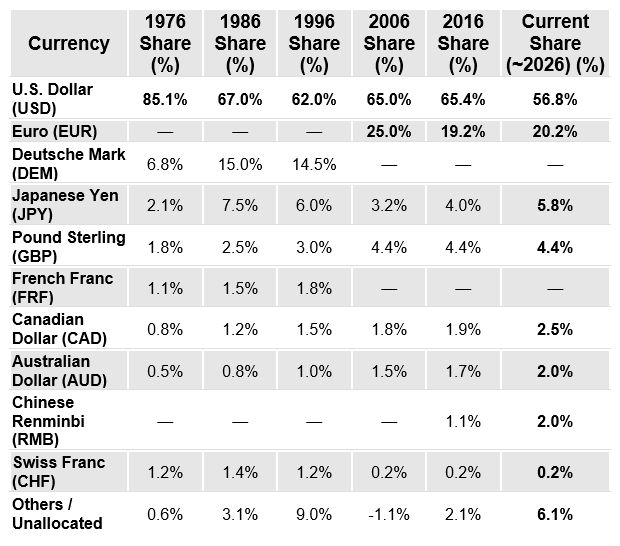
Consider by way of background the shifts in global central bank allocations across the major reserve over the past 50 years
The Erosion Of The Dollar’s Reserve Share
Since the end of WWII, when world financial order was reconstructed, US Treasury bonds served as the ultimate global risk-free asset and the backbone of FX reserves. Supply, cannibalisation and escalating fiscal deficits have accelerated a decline in the US$ dominance of the World financial order.
Foreign central banks have not completely unloaded their existing bonds wholesale, but total foreign ownership has remained structurally flat at around $7 trillion for a decade. Meanwhile the total pool of global reserves continues to expand, and US$’s relative share is shrinking. Major holders such as Japan, China, and the UK have systematically reduced their nominal holdings - by way of example China’s holdings recently plunged to $633.4 billion, which is the lowest level seen since the 2008 financial crisis.
Diversification Of Assets Has Its Parameters
De-dollarisation points to greater allocation of reserves to precious metals, but such single-asset exposure remains highly speculative. In this uncertain geo-Political landscape, gold experiences price volatility. Gold remains susceptible to aggressive central bank policy shifts, interest rate hikes, as well as domestic regulatory interventions. Financial security requires anchoring any precious metals allocations of assets in a way that balances hard commodities with cash liquidity and productive, cash-generating global equities. As the massive supply of US debt reduces the yield and safety premium traditionally associated with Treasuries, central banks are actively substituting paper debt with hard assets. Central banks and reserve asset managers are treating gold as the primary alternative anchor. The gold and US debt markets are now of comparable value and size (around $25 trillion and $30 trillion respectively.). Gold prices increased exponentially, undermining the assumption that US Government Debt is the only viable safe haven.
What Assets Have The Ability To Act As Global Resaves?
A currency's ability to act as a global reserve depends on the size, depth, and liquidity of its underlying bond market. Global capital fleeing the USD needs a massive, safe place to rest. Other reserve currencies have a very limited capacity to absorb a major flight from the US dollar (USD). Their central banks strongly resist taking on that role, although alternative currencies can absorb marginal shifts perhaps up to, no single currency or even a consortium of reserve currencies possesses the structural capacity or, more importantly, have the political willingness to replace the US dollar.
Central banks actively resist becoming the dominant global reserve currency due to severe economic trade-offs. Global reserve currencies must run continuous trade deficits in order to provide liquidity by buying more from abroad than it sells. As the liability builds up quicker than the value of the underlying assets, doubt about the value and confidence in the currency grow.
Consider the following four reserve currencies:
- The Euro would resist becoming the principle global reserve currency because it would have to issue massive amounts of debt to supply the world with liquidity. A global flight into the Euro would sharply appreciate its value. This would impact Eurozone exporters, especially Germany by making their goods too expensive globally and blunting economic growth.
- £Sterling accounts for a surprisingly high level of global currency reserve because of the importance of London as a financial centre, its highly liquid capital markets and trust in the UK’s financial and legal system. However, the Bank of England with full support of the Government would resist more than a minimal increase in sterling’s global reserve holdings because of the severe impact on an already fragile economy.
- The Renmimbi could not become the principle global reserve currency, unless or until China must dismantle its capital controls by letting money flow freely in and out of the country. China places financial control above free capital flows, which would remove the Government’s ability to manage its exchange rate, intervene in domestic markets, and prevent domestic capital flight during crises.
- The Japanese yen would be deemed unsuitable because Japan’s economy is fundamentally built on manufacturing and exports. A major influx of reserve capital would drive the Yen higher, killing export competitiveness. Japan's domestic bond market is already tightly managed to keep government borrowing costs low; global interference would disrupt this balance.
The Challenges Of Reallocation Of Global Currency Reserves To Gold

Global supply of physical gold is limited would by mining limitations. To absorb even a fraction of the liquidity currently held in global fiat currency reserve systems, the price of gold would rise to between $5,200 to $6,000 per ounce. Long-term government bonds have symbolised a breakdown in this relationship between the long term government bond market and gold simultaneously holds equities and gold.
Gold is a heavy physical product, which is costly to store and does not pay interest, though it can be lent collateralised, costly to store. Using gold as primary reserve asset would slow down access to liquidity in the global financial system compared to the digital, frictionless transaction speed of U.S. debt and equity systems.
Central banks are repatriating gold to their own jurisdiction. Central banks in nations like India, Poland, Turkey, and Germany have aggressively repatriated their bullion reserves out of custody centres like the New York Fed and the Bank of England to maintain sovereign custody.
What Are The Consequences For The US$?
Historically, global demand for dollars to fund central bank reserves allowed the U.S. to borrow cheaply. As central banks substitute US Government Bonds for physical gold, the US Government Bonds loses its captive buyer market. The loss of that market undermines the USA’s ability to painlessly finance its ballooning debt. The U.S. government must offer higher yields to attract buyers. Every percentage point decline in foreign treasury holdings relative to GDP drives up interest rates, directly accelerating the U.S. debt servicing crisis. Weaker demanded for the US dollar lowers the currency's purchasing power globally and consequently forces the U.S. to pay more for imported goods, introducing persistent, supply-side inflation into the domestic economy. Finally, the USA Political power is weakened.
The global dominance of the dollar gives the U.S. unparalleled geopolitical leverage. Physical gold can be stored domestically and transacted outside of the SWIFT network, which limits Washington's ability to enforce economic blockades and financial penalties.
So In Conclusion What Is The Future Global Financial System Look Like?
- The shift away from the US dollar does not imply a total collapse of the dollar but rather the fragmentation of the global financial architecture. The world is actively organizing around regional trade settlements (such as the BRICS local currency initiatives) and alternative transaction pipelines (like China’s Cross-border Interbank Payment Services Network). They use gold to settle final imbalances but there is liquidity friction.
- The dilution of the US Treasury market has been the catalyst for fragmentation of the global reserve architecture into localised and non-aligned blocs- termed “regionalisation of Reserves.”
- Central banks are diversifying into the Euro, the British Pound, and non-traditional reserve currencies to hedge against exchange rate volatility and US institutional credibility risks but are extending their interest to digital currencies which enable faster, cheaper and more direct cross-border transactions without the use of intermediate banks
- To support these altered reserve balances, nations are bypassing Western banking pipelines. China's Cross-Border Interbank Payment System (CIPS) saw transactions balloon to trillions of yuan, allowing trade and reserve accumulation to occur completely outside the dollar ecosystem.